
 The common black-eared opossum in the symbolic and iconographic universe. From the effigy ornaments in the lesser Antilles to the European graphics of Simivulpa and its variants in the 16th – 17th centuries
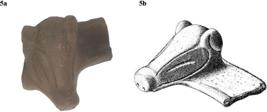
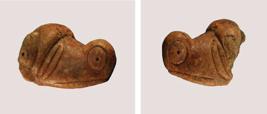
This study focuses on the aesthetic analysis, iconographic variants, and symbolism of the common black-eared opossum (Didelphis marsupialis Linnaeus 1758) in ceramic ornaments of agro-ceramic origin of the Saladoid tradition with Barrancoid influence, located in the south of the Lesser Antilles arc and Venezuela, currently held in different collections, scientific academies, and museums around the world, particularly in the Caribbean and United States. Likewise, it will study an entire corpus of prints with descriptions and illustrations of the marsupial, the latter being elaborated by European artists through wood engravings or etchings. For this purpose, chroniclers and artists often relied on the analogical outline of Aristotle, disarticulating the didelphidae into anatomic parts to later compare them with those of other animals according to their degree of similarity, usually being with species of the so-called Old World, in order to create a ‘new’ concept, in reality, an anomalous creature, resulting from the juxtaposition of images of the ‘old’ over the ‘new’, in order to show the intelligible and unknown of the Caribbean world in a way that is comprehensible and accessible to the human mind, with the objective of providing zoological continuity and closing the gaps that once separated both ‘worlds’, in other words, the semiosis of Charles Sanders Peirce.
Keywords:
common opossum; marsupial;
Didelphis marsupialis
; simivulpa; Lesser Antilles; ornament; engraving; iconography; symbolism
 Thumbnail
 Thumbnail
 Thumbnail
 Thumbnail
 Thumbnail
 Thumbnail
 Thumbnail
 Thumbnail
 Thumbnail
 Thumbnail
 Thumbnail
 Thumbnail
 Thumbnail
 Thumbnail
 Thumbnail
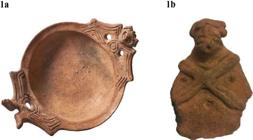
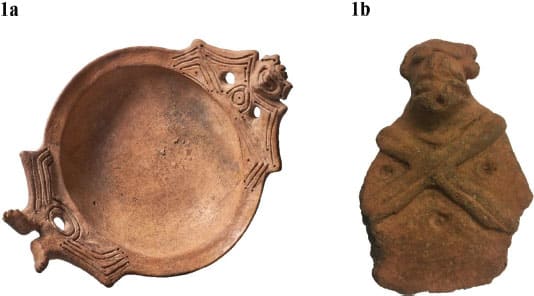 Note. Figure 1a. Courtesy of the García Arévalo Foundation, Santo Domingo; Figure 1b. National Museum of World Cultures, INAH, Mexico City, Cuba Collection. Inventory No. 10-134759.
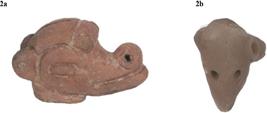
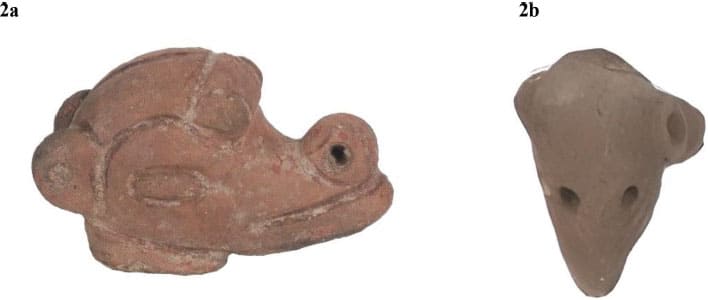 Note. National Museum of the American Indian (NMAI), belonging to the Smithsonian Institution, Washington D.C. Catalog number: 3/2822; Figure 2b. National Museum of the American Indian (NMAI), belonging to the Smithsonian Institution, Washington D.C. Catalog number: 3/2807.
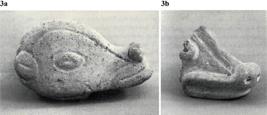
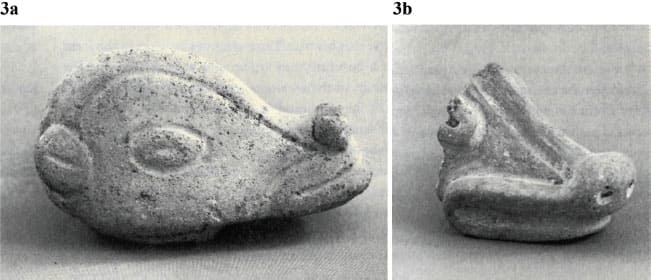 Note. Figure 3a. National Museum and Art Gallery, Trinidad. Dimensions: 7.6 cm long.; Figure 3b. National Museum and Art Gallery, Trinidad. Dimensions: 4-5 cm. Courtesy of Lawrence Waldron, City University of New York. Photographs taken by Lawrence Waldron.
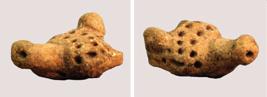
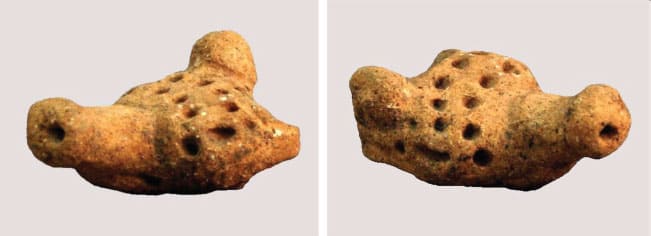 Note. Figures Unknown site, Granada. Dimensions: 2.5 cm. Florida Museum of Natural History, Gainesville. Courtesy of Lawrence Waldron, City University of New York. Courtesy of Lawrence Waldron, City University of New York. Photographs taken by Lawrence Waldron.
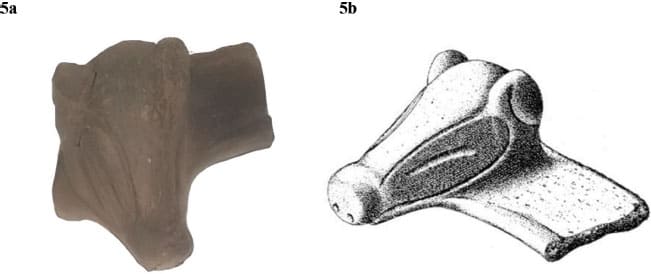 Note. Figure 5a. National Museum of the American Indian (NMAI), belonging to the Smithsonian Institution, Washington D.C. Catalog number: 3/2807; Figure 6b. Design by
 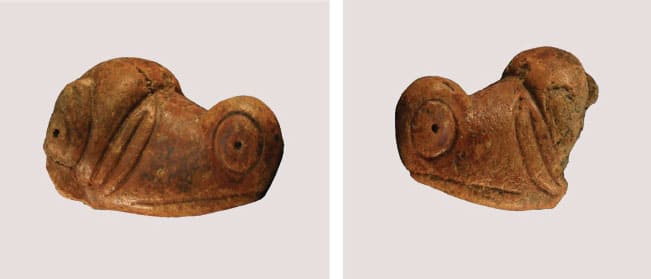 Note. Figure Originating from Lagon Doux, Mayaro, Trinidad. Dimensions: 4 cm. Tobago Museum, Fort King George, Tobago. Courtesy of Lawrence Waldron, City University of New York.
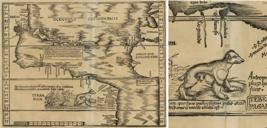
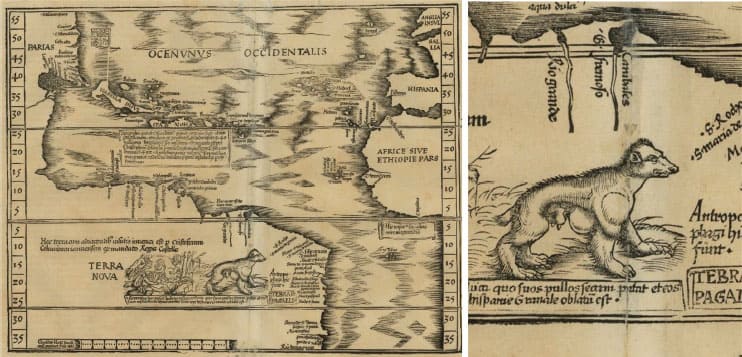 Note. Source: Tabula Terre Nove by Martin Waldseemüller, for the 1513 edition of the Geography by Claudius Ptolemy, printed in Strasbourg.
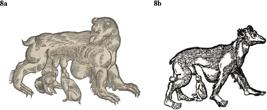
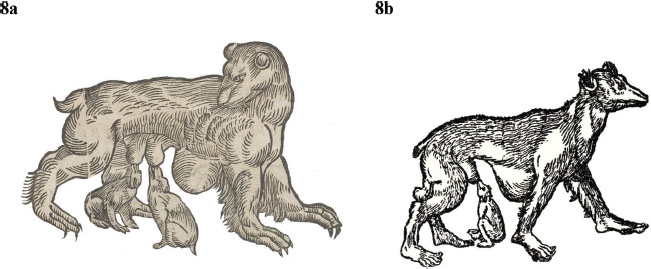 Note. Figure 8a. Xylography by Conrad Gessner contained in the Historiæ animalium Li.b I. de Quadrupedibus uiuiparis. Zürich (in Romansh Turitg), ed. Froschoverum,
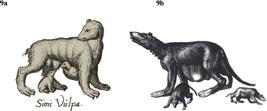
 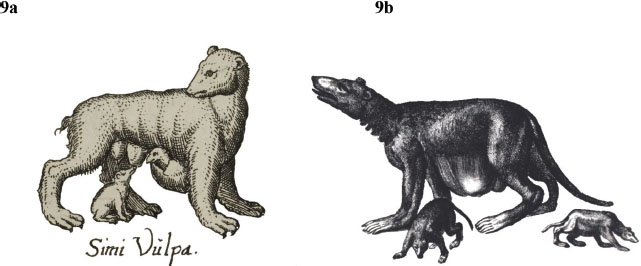 Note. Figure. 9a. Detail by Levinus Hulsius in Brevis & admiranda descriptio Regni Guianae. Nürnberg, 1599, p. 5. National Library of Spain, Madrid, R/14223. Figure 9b. Detail by Jacob van Meurs in America: being the lastest, and most accurate description of the New World by John Ogilby. London, 1671, ch. 3, p. 59.
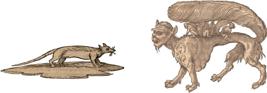
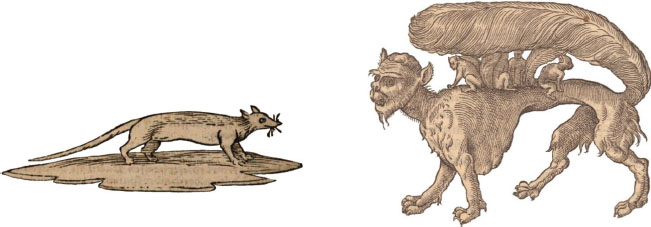 Note. Source: Figure 10a. Graphic contained in the Warhaftige Historia und Beschreibung by Hans Staden (Marburg, 1557), ch. 30. Figure 10b. Graphic contained in the Singularitez de la France Antarctique of the Fransiscan André Thevet (París,
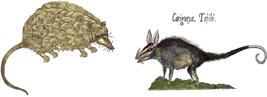
 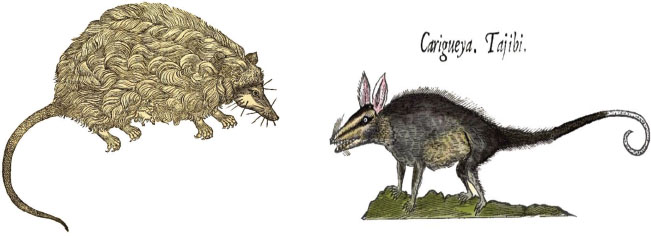 Note. Source: Figure 11a. Graphic contained in Historia Naturæ by Johannes Eusebius Nieremberg (Antwerp, 1635), bk. 9, ch. 4, p. 156; Figure 11b. Graphic contained in Historia naturalis Brasiliae by Willem Piso and Georg Marcgraf (Antwerp, 1648), bk. 9, ch. 4, p. 156.
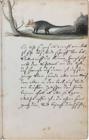
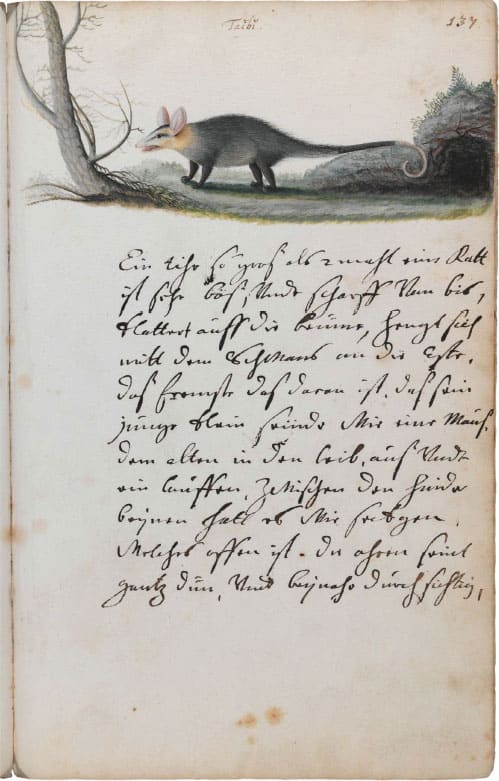 Note. Jagiellonian Library, Kraków, Libri Picturari A 36, p. 137.
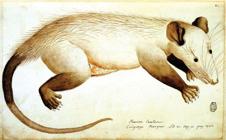
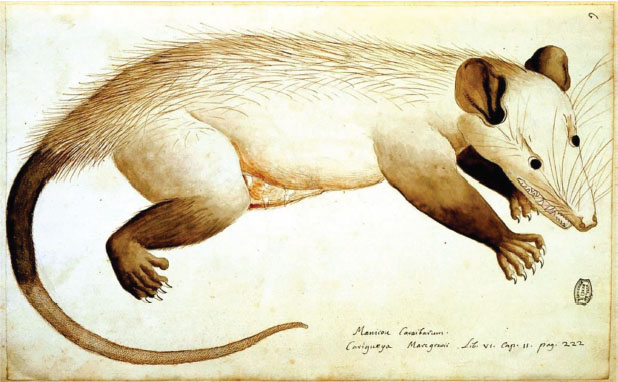 Note. Centrale du Muséum National d´Histoire Naturelle, París, Plumier MS 27.
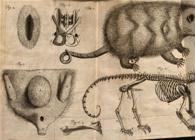
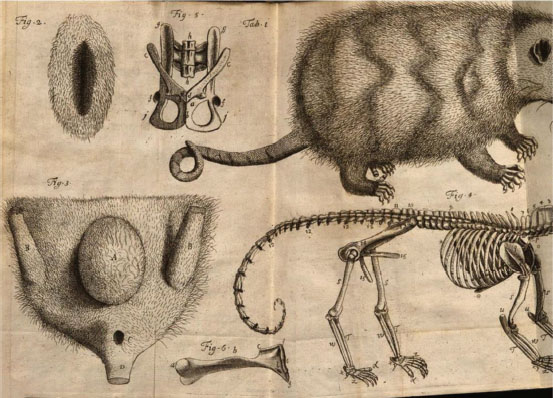 Note. Source. Etching by Edward Tyson in Carigueya, ser Marsupiale Americanum: or, the Anatomy of an Opossum, Dissected at Gresham College. London, 1698.
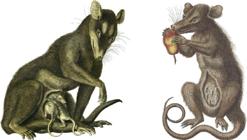
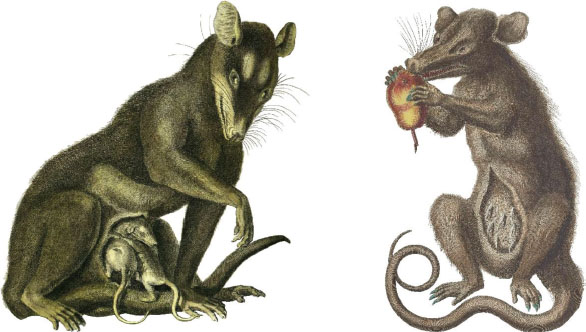 Note. Source: Table 38 and 39 of Albertus Seba, contained in the first volume of Locupletissimi rerum naturalium thesauri accurata descriptio. Amsterdam, 1734.